Monday, September 14, 2009

Word Search about Coast to Coast

Click the following picture link to visit the interactive wordsearch made by Regan, Megan, and Callum. This is all based on the Coast to Coast sports challenge. Keep posted and you will learn more.

James gets descriptive!

James was given 2 photos. One was of a man who was drinking out of a coffee cup, the other was of a busy French cafe. Here is how james added the 2 pictures together using descriptive language.

Sunday, September 13, 2009

Blogging Challenge - week 2


Click screen shot to go to week 2 challenges

Friday, September 11, 2009

Tuesday, September 8, 2009

Blogging Challenge

Question Three: what do you hope to get out of the blogging challenge by the end of 10 weeks?
Wordle: question three

http://www.wordle.net/.

Blogging Challenge

Question Two: What do you hape some of the activities include?
Wordle: question 2

Blogging Challenge

Question One: Why did you join the blogging challenge?

Wordle: question 1 blogging challenge

http://www.wordle.net/.

Friday, September 4, 2009

Relationship between kinetic and potential energy

What did we learn from out experiment where we changed the height of our marble ramp? we looked at the relationship between height (more potential energy) and kinetic energy (speed).

Awesome challenging maths tasks


Room Ten is enjoying the book "Go Figure" as it is provides a lot of interesting and challenging tasks. This activity was TO MAKE A ICOSAHEDRON using 3 pieces of paper and 3 specified cuts. This was fun fun fun!!!!
Check out the book "Go Figure - a totally cool book about numbers" by Johnny Ball.

Wednesday, September 2, 2009

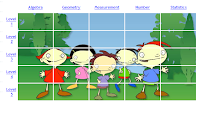
Numeracy in Action

Todays groups looked at 7 lots of 38 and how we could work it out. They decided it was easiest to have 3 lots of 10 and 2 lots of 4 in each column. That made it easier to work out 21 x 10 = 210 and then 4 x 14 = 56. It was easy after that as 56 + 210 = 265as the answer. We then talked about 38 being close to 40 so 40 x 7 = 280 and because we added 7 lots of 2 we took off 14 from 280 which gave us 265 as well. Our last strategy was to look at 7 x 30 which is 210 and then times the remainder 8 by 7 which is 56 and add 56 onto 210 also giving us 265. Phew ..... that was heaps of strategies in one lesson but it really does make it a lot quicker to answer things in our heads (imaging). OUR LEARNING INTENTION WAS: I AM LEARNING TO SOLVE MULTIPLICATION PROBLEMS BY USING A VARIETY OF MENTAL STRATEGIES.


Numeracy in Room Ten

The Numeracy Project is focused on developing children's understanding of numbers, and their ability to use numbers to solve problems. Children may solve number problems by counting, adding, subtracting, multiplying, dividing, or combinations of these.
As part of the Numeracy Project children should be learning to:
* enjoy working with numbers
* make sense of numbers - how big they are, how they relate to other numbers, and how they behave
* solve mathematical problems - whether real life or imaginary
* calculate in their heads whenever possible, rather than using a calculator or pen and paper
* show that they understand maths, using equipment, diagrams and pictures
* explain and record the methods they use to work out problems
* accept challenges and work at levels that stretch them
* work with others and by themselves
* discuss how they tackle mathematical problems - with other students, their teacher and you!

This information is fom the NZ Maths site run by the NZ Ministry of education.

In Room Ten each group has their own book where they write their learning intention, plan, 'work out', and solve equations showing a process. These books can be used by the students at any stage to revisit work or for new problems. Everyone gets a turn to write and they are able to sign their work and take ownership of problems solved. A lot of the numeracy work is with materials aiming towards 'imaging' which is to work problems out in their head using one or more strategies. The workbook for the groups is primarily a place to share new strategies.

Tuesday, September 1, 2009

Kinetic and Potential energy

In order for us to begin learning about roller coasters we need to understand the basics of physics. Potential and kinetic energy are hugely important in the success of roller coasters. Room ten participated in an activity involving marbles and different heights - looking at the relationship between potential and kinetic energy. Potential energy is when someting is not moving but is storing its (potential) energy. Kinetic energy is speed energy (movement). check out the links under the inquiry heading on the left hand side of the blog for more.